Spotlight
From Kerala’s Rains to NASA’s Skies
From Kerala’s rains to NASA, Sujay Kumar follows Earth’s water from space. A scientist’s journey into hidden shortages, shifting monsoons and a resource we cannot replace.
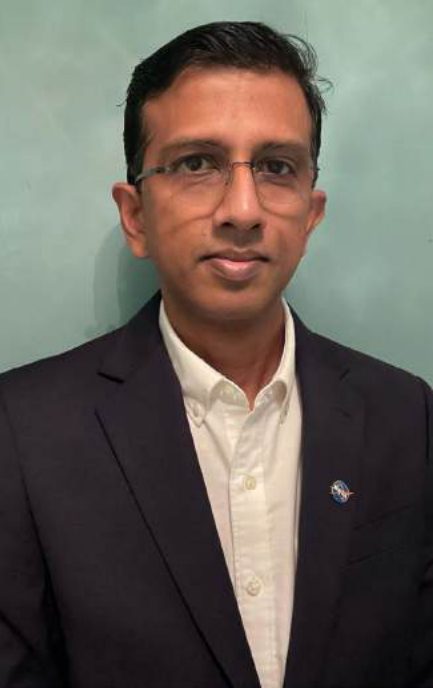
It was a pleasure to interview Dr. Sujay Kumar (B.Tech Civil Engineering from the Indian Institute of Technology-IIT Bombay, 1996 & Hostel-6), Deputy Chief of Hydrological Sciences Lab at the NASA Goddard Space Flight Center in Greenbelt, Maryland. This virtual interview, conducted over multiple sessions, was itself a fitting metaphor for the story it uncovered - two people, worlds apart, connecting across time zones and continents. We spoke while we both were travelling, including one conversation while I was in transit at Amsterdam airport and Sujay was enjoying the Monsoon rains back in God’s own country. History is replete with stories of individuals who dream of worlds far beyond their circumstances and traverse long, winding roads to get there. Sujay Kumar fits this mold, to the T. What makes it special for us is that he is also an IIT Bombay alumnus. Let’s join him on his journey, literally from the backwaters of Kerala to the heavens above, as he trains his gaze on the water that defines our “blue planet”.
Roots in God’s Own Country
Sujay’s journey began in an archetypal middle-class family in a small town close to Kochi, in Kerala. Life was simple, anchored by home-cooked idiyappam, chutney, sambhar and the goodness of adjoining farms. Many boys of Sujay’s generation in the Kerala countryside were taught to scale coconut trees to gather fruit, a feat that looks daredevil to outsiders but becomes mundane with skill and practice. It remains a neat analogy for working hard and smart towards a goal and reaping the reward as just due.
Sujay recalls being a sincere student who could easily have secured admission to a good private school. But his father took a more altruistic view. If Sujay’s mother, herself a teacher in a local government school, wasn’t reason enough to enroll their son there, it wasn’t fair to expect other families to consider it for their children. So, Sujay entered the local government school and made the most of what it offered, a trait of adaptability that has stayed with him.
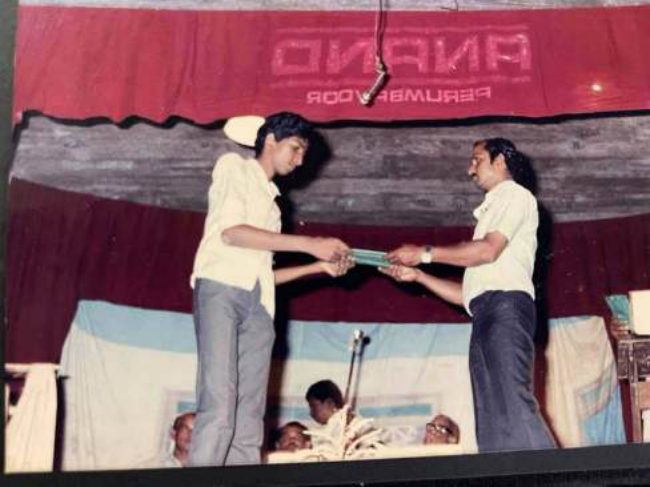
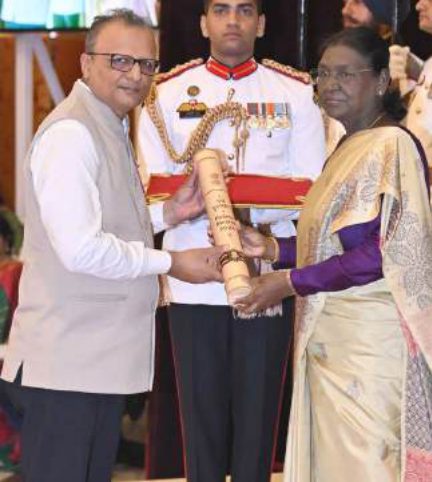
One memory Sujay returns to with pride is a prize his father gave him during high school for academic and overall achievement (photo 1). That was special per Sujay. His father, an engineer with the State government, cared deeply about K-12 education and believed parents needed to be active partners in it. He rallied other parents into what we today would recognize as a Parent-Teacher Association (PTA) and served for years as its chair, shaping Sujay’s instincts about hard work and fairness.
Sujay’s coming of age at IIT Bombay Campus: The lad turns into a Man
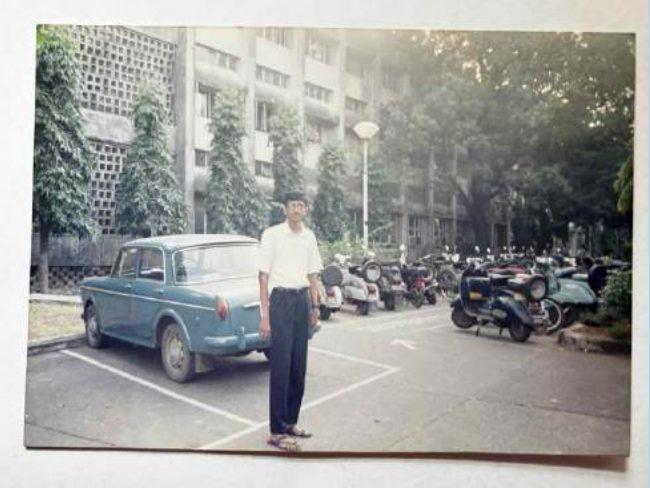
Like most aspiring students of his generation, Sujay aspired to study at an IIT and was delighted to land a berth at IIT Bombay in Civil Engineering (photo 2). He was allotted Hostel 6, then on the fringes of campus, which meant the longest commute to lecture halls and almost everything else. He could have chosen another institution or branch but preferred an environment that challenged him.
He was active in sports at IITB, basketball and running among them, and still recalls a senior’s remark about introspecting before committing one’s time to any pursuit. That lesson came into sharp focus when Sujay had to choose between travelling for the Inter-IIT Sports Meet and submitting graduate school applications to the US. He chose the latter. As they say, the rest is history.
Having grown up in a part of Kerala with arguably the longest monsoon season on the subcontinent, water was a near-constant presence in Sujay’s early life. So, within Civil Engineering, he gravitated naturally towards hydrology and fluid dynamics. He credits Prof B.S. Pani, then department chairman, for making time for him while ‘wetting’ his appetite for water science, also noting the coincidence of Prof. Pani dedicating an academic career to “pani”, the Hindi word for “water”. Sujay briefly explored Structural Engineering, but was destined to return to water science, though via a convoluted & scenic detour! Before his international adventures, as Powai was drenched in Monsoon rains, Sujay collected his bachelor’s degree and an institute silver medal for topping his class. Photo 3 from a Civil Engineering passing out batch in 1995 above captures the transition from IITB to the world beyond.
Heavenly adventures beckon, on the ‘other’ side of the Planet
The next chapter shifts continents. Sujay landed at North Carolina State University (NCSU) in the intellectually vibrant Research Triangle, a setting he remembers as an interesting blend of contrasts - warm and cold, urban and rural. Though he had developed a taste for hydrology at IIT Bombay, graduate school pulled him deeper into environmental engineering, a foundation he later realized was critical to his eventual work in remote sensing & hydrology. It is fitting that Sujay gravitated towards Remote sensing, a theme that the Indian Central (federal) government had tasked IIT Bombay with developing in Indian academia from the mid 1970s via the establishment of specialized centers like the Centre for Studies in Resource Engineering (CSRE).
Sujay credits sustained strength in computation & modelling with opening the door to a postdoctoral fellowship at the National Aeronautics & Space Administration (NASA) and shaping his career path as a scientist and civil servant, a position he likens to the Indian Administrative Service (IAS) in India in terms of responsibility. NASA civil servants are also expected to represent the agency’s mission properly, within the US and beyond. At NASA’s Greenbelt center in Maryland, a science center of excellence, Sujay gradually brought together his experiences in Hydrology, Fluid Dynamics and Operations Research, while still emphasizing that depth in one or more areas remains critical in research. What has differentiated him, he feels, is the blend of a civil engineering foundation from IIT Bombay and the computational rigor he built in graduate school, brought to bear on one of the defining resources of our time, “Water”.
Watching Earth’s water from space
NASA science & research is organized into four primary divisions, including Earth science. NASA explores worlds far removed from Earth, but for now Earth remains the only habitable planet we know. Essentially, we need to study & protect what we have right here on Earth. The agency’s mission statement is NASA explores the unknown in air and space, innovates for the benefit of humanity, and inspires the world through discovery. At NASA, science and its motivating questions drive the missions, while engineers create the instruments that make it possible. Scientists justify requirements and parameters; sometimes large technology platforms challenge scientists to frame new questions. Sujay has spent most of his career at NASA, contributing prolifically to Earth Sciences with steadily increasing responsibility. He fondly says NASA offers opportunities to pursue ideas that have bothered one for long - a heaven-sent setting for a scientist!
People tend to associate NASA with rockets, space shuttles and telescopes. Sujay points out that his focus remains “water” in its many forms, approached from a data and computational standpoint rather than through the instruments that capture it. His work centers on Earth observation from space, applied to the planet’s water cycle and resources across oceans, cryosphere and atmosphere. This is distinct from operational weather satellites used for forecasting and flood alerts, which fall under the National Oceanics & Atmospheric Administration (NOAA). NASA and NOAA have related but distinct mandates: exploration and discovery on one side, operational services to society and the economy on the other. In India, these functions sit together under the Ministry of Earth Sciences, with the Indian Meteorological Department (IMD) embedded within it.
Change is the only constant and Earth’s climate is no exception. Monitoring climate evolution requires data, data & more data, enabled by technology. NASA studies water via simulations, but there is no substitute for Earth observation satellites that collect vast volumes of raw data on snow, precipitation and groundwater. These data must be processed, compressed and archived before becoming usable products. This scale has allowed Sujay and colleagues to build models that track and predict the shifting hydrological cycle across space and time. He sees edge computing on satellites as a potential game changer, particularly for faster flood response, and foresees Large Language Model (LLM)-enabled actionable projections for end-users, not just raw data for specialists.
These platforms scan the planet’s surface and oceans, and newer satellites even peer beneath the ground, sensing different features through different wavelengths of the electromagnetic spectrum. Such programs help society project into the future and adapt to extreme weather and shifting rainfall patterns. Sujay states a profound fact: We look for alternative energy sources, but there is no substitute for water! Most of Earth’s water is not easily accessible or usable. Only about 2-3% is fresh water, much of it locked in glaciers and icecaps, while about a quarter of terrestrial water in India is held as groundwater.
Asked to name a favorite NASA mission, Sujay didn’t think twice: “Tom & Jerry.” He meant GRACE (Gravity Recovery & Climate Experiment), a pair of satellites orbiting Earth in tandem. Unlike many Earth observation platforms, GRACE’s two satellites follow each other; as gravitational pull shifts beneath them due to geo-hydrological mass changes, they adjust position to maintain distance. GRACE has monitored changes in local gravity, the hydrological cycle, Earth’s orbit linked to major dams like the Three Gorges Dam, and gravity signals from earthquakes and volcanoes.
Sujay spoke with infectious enthusiasm about NISAR (NASA-ISRO Synthetic Aperture Radar), the joint NASA-Indian Space Research Organisation (ISRO) Earth observation satellite launched from Sriharikota. Sujay is working with the NISAR data, which maps the entire Earth every twelve days or so and streams back data from its Long (L)- & Short (S)-band Radars. These data are invaluable for high-resolution studies of the hydrological cycle, including soil moisture. He emphasized that the mission’s high-resolution observations could significantly benefit water and crop management efforts, supporting more resilient agriculture and potentially improved outcomes for communities in India.
SWOT is an interferometer-based NASA satellite that monitors ocean height and provides information about currents, eddies and related physical oceanography features. It can also monitor river height, a transformative tool for river systems spanning national boundaries. A case in point is the GERD (Great Ethiopian Renaissance Dam) across the Nile in Ethiopia before it crosses into Egypt. Such situations affect agriculture, especially as current estimates suggest ~70% of fresh water is used in agriculture. Remote sensing can now monitor river height along its flow path. Sujay summarizes this as science being agnostic to politics.
Our discussion also veered towards start-ups in aerospace. Notwithstanding the achievement of Hyderabad-based Skyroot in launching a rocket into space, Sujay feels these are still early days, and the role of private-sector satellites will only increase, including for Earth observations. It was good to know that the US private sector too has satellites in space imaging at geospatial resolutions as fine as ~30 meters. Such complementarity with agencies like NASA bodes well for monitoring the pulse of our planet.
Water closer to Home
There is still no real substitute for field-based data collection and ground truthing of hydrological features. But Sujay believes we are approaching a point where water-related data can no longer be treated as the sole preserve of individual nations, especially where rivers and glaciers cross borders. Satellite remote sensing is also becoming increasingly capable of estimating groundwater resources and water-table depth.
Asked about a landmark GRACE-based study in the scientific journal Nature 15 plus years ago that flagged critically low water tables across northern India, Sujay confirmed it as important work by several NASA colleagues.
Urgent policy changes to groundwater usage may be necessary to arrest falling water tables in parts of North India.
What struck me most was how paradoxical that finding feels on the ground. Drive from Delhi to Haridwar and you’ll pass lush fields and roadside Dhabas, an all-is-well tableau. What it conceals is what happens beneath the surface, where farmers pump groundwater to feed thirstier crops, a clearly unsustainable situation. Surface abundance can mask scarcity underneath. Similar scenarios play out in the western US, including California’s Central Valley. Even river width can now be estimated from satellites to within a few meters, showing how much of this once-invisible world has become measurable.
Sujay peers outside his home in Kerala with heavy rains lashing the Malabar coast, even as the Monsoon is subdued across swaths of the subcontinent. He looks heavenwards at the ominous clouds and says we take the Monsoon, a critical component of the hydrological cycle, for granted. It works like clockwork, but Monsoonal excursions lead to landslides, flooding and compromised agricultural yields. With the recent tragedy in Nepal, do we need reinforcement of how critical a properly tuned Hydrologic cycle is & needs to be?
The discourse thus far has centered on the quantitative aspects of the water cycle, but water quality deserves more focus too. Pollution impacts travel farther than one might imagine. For instance, Delhi’s infamous air pollution can be felt on Himalayan glaciers as soot deposition. This is not merely cosmetic; it has implications for environmental change and the water feeding Himalayan rivers that serve North India’s agricultural heartland.
This and That
Asked whether he’d ever had an ‘aha’ moment, Sujay smilingly shrugged off the idea as reserved for a fortunate, rarefied class of scientist. His own career, he says, has instead been punctuated by highs at aperiodic points along the way. The opportunity to work in an interdisciplinary area of science with real implications for society remains exhilarating. So much remains to be discovered.
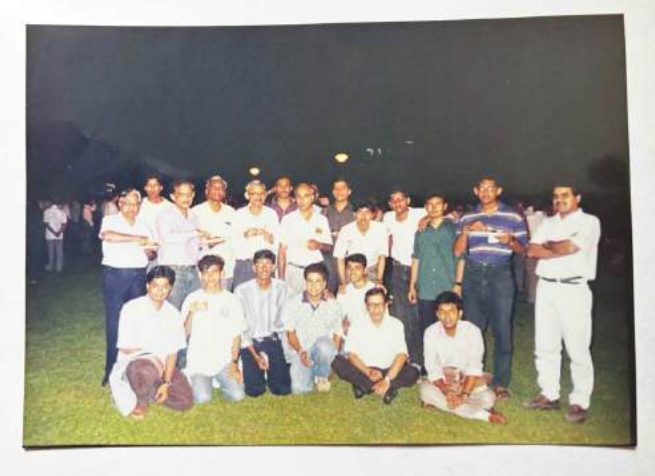
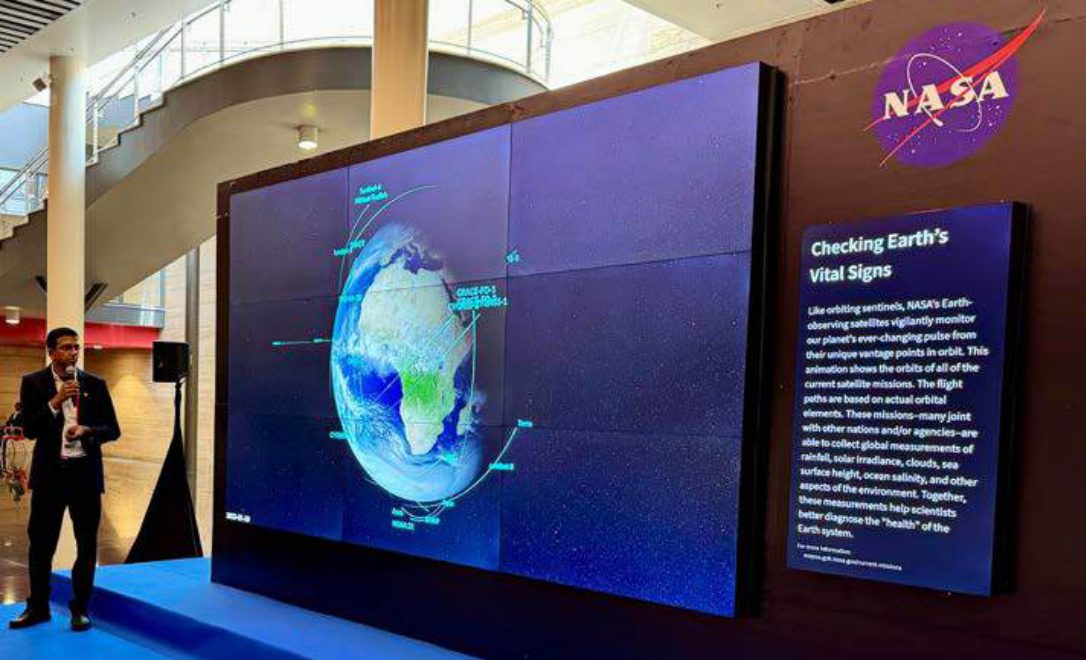
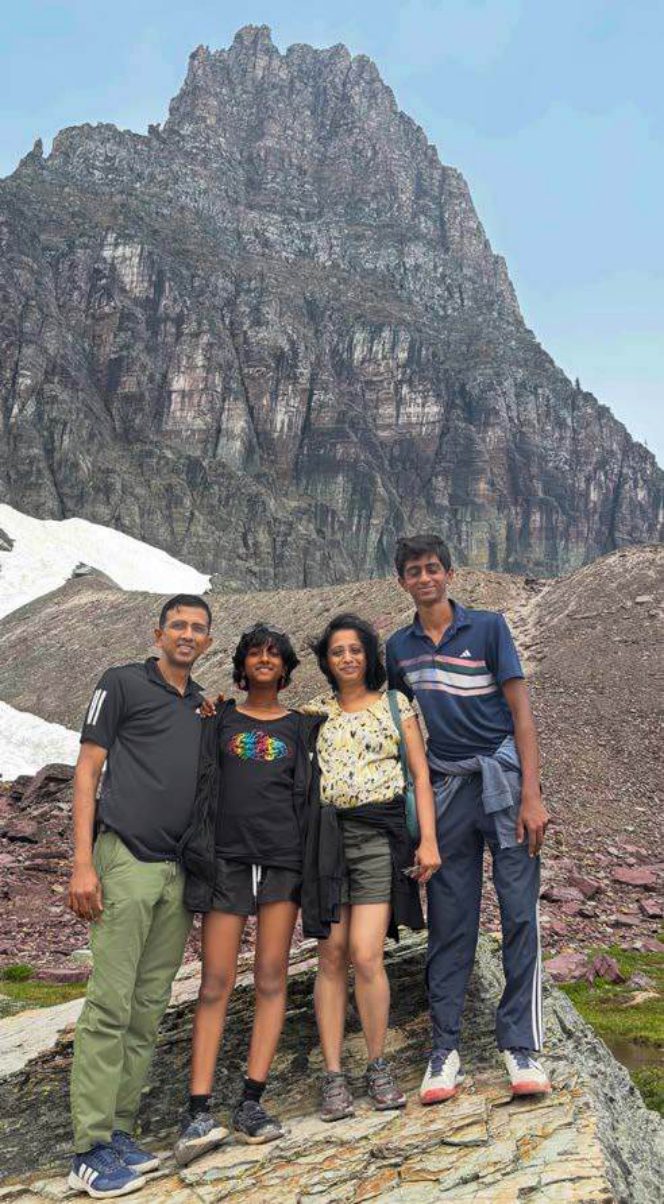
He remains a regular participant in science outreach (photo 4 to the top of this page), including in Kerala, and never ceases to be amazed by the curiosity and enthusiasm he finds in children. NASA itself inspires wonder, and water is something everyone can relate to. For all that his professional plate stays full, Sujay recharges by travelling to India and his native village, where he still feels the tight sense of community. It matters that his children experience that way of life too and stay connected to their roots while growing up as American citizens in Maryland. Photo 5 to the right captures Sujay on earthly family adventures in the United States. What a spectacular Geological setting!
It was only fitting that we concluded our trans-continental chat by circling back to Sujay’s formative years at IITB, the phase that laid foundations for the leader he has become.
A sort of rapid-fire to gauge the persona behind Sujay’s scientific discoveries:
Early morning person or night owl: Get going at the crack of dawn, as is typical in South India. Sujay didn’t attempt night-outs at IITB and says he might have failed an examination had he tried it sleep deprived.
One Indian language that every Indian should learn: Hindi, for it binds India.
One film that everyone should watch: JJWS - Jo Jeeta Wahi Sikander (maybe the story of his life as well, many of his batch thought that they were the lovable underdog Aamir Khan when biking down the hill at IITB)!
How do you deal with criticism? Sujay addressed this from a scientist’s standpoint. When submitting a manuscript, understand the subject matter, set realistic expectations, and assume rejection is possible. Take criticism with a grain of salt. The same holds for responses from authors when Sujay was a reviewer.
Reflecting on his life, Sujay mentioned that NASA was and is an exhilarating experience, but working on water, the essence of life, gives him the feeling that his life and work counted for something. Many dream big & dream on, but Sujay managed to live his dream!
About the author
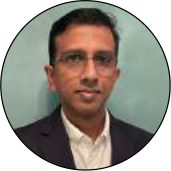
Dr. Sujay V. Kumar, an IIT Bombay Civil Engineering graduate and Institute Silver Medalist, is Assistant Lab Chief at NASA’s Hydrological Sciences Laboratory. He holds a Ph.D. from North Carolina State University and developed NASA’s Land Information System, named NASA Software of the Year in 2005. With over 200 peer-reviewed publications, he has received NASA’s Outstanding Leadership Medal, Exceptional Technology Achievement Medal, and the Arthur S. Flemming Award. His research advances weather prediction, drought monitoring, and sustainable water management worldwide.

Join the conversation
Comments are moderated and may take a little while to appear. Please keep the discussion respectful and on topic.
Comments open soon.