Spotlight
The Restless Polymath
From Infosys to election strategy and public broadcasting, Shashi Shekhar Vempati kept reinventing himself. An unconventional career powered by curiosity, mentors and calculated leaps.
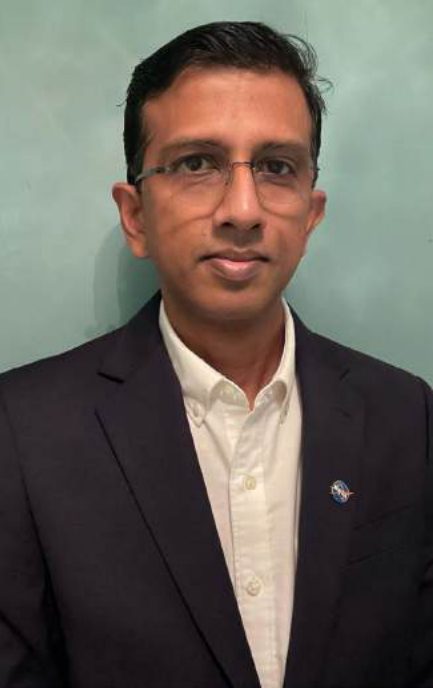
Shashi Shekar Vempati (SSV) graduated from the Indian Institute of Technology (IIT), Bombay with a B.Tech in Chemical Engineering in 1995. He resided in Hostel-7 during his IITB years. Post graduation, he took up his first job at Engineers India Limited (EIL) in the National Capital Region (NCR), being placed in their Environmental Engineering Division. He subsequently moved to Infosys in Bangalore during the mid 1990s when the company was still in its early phase. Shashi had a long innings of ~ fifteen years at Infosys, a period of great technological change and transitions.
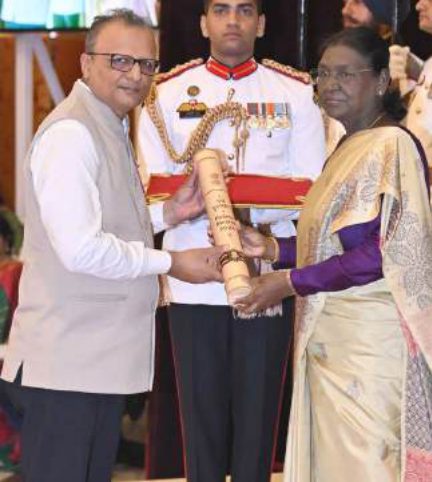
Shashi has been a prolific writer, initially contributing anonymously to blogs in Indian newspapers. From 2017 to 2022, SSV led Prasar Bharati, the hallowed Indian public broadcasting agency overseeing Doordarshan and All India Radio (AIR). Shashi is also a best-selling author of a book entitled Collective Spirit, Concrete Action: Mann Ki Baat and its influence on India, exploring and analyzing his experiences with PM Modi’s long running Radio broadcast Mann ki Baat. He continues to be at the forefront of India’s indigenous AI efforts guiding the BharatGen consortium by serving on its board. Shashi currently leads the Indian Central board of Film Certification (CBFC). SSV was honored with the Padma Shri in 2026 by the Government of India for his services to public broadcasting, media reforms & digital policy.
An unprecedented story of constant change via paths rarely traversed
Before these sessions with Shashi Shekhar Vempati (SSV), I asked myself: how does one prepare for an interview with someone who has traversed such an atypical path? When I finally met SSV, we simply went with the flow, and it turned out to be spontaneous, seamless chat & rather surprisingly anchored in straight talk. A facet that immediately becomes apparent is that Shashi seems to have a pan-India diction. More on this as I vicariously take you along for a trip down Shashi’s memory lane.
One might imagine SSV, of the batch of 1995 (Hostel-7), Chemical Engineering, as an undergraduate student sprinting along the Infinite Corridor at IIT Bombay. Shashi candidly admits he fits the mold of the “average” student rather than a career chemical engineer. Told in the early 1990s that he would one day lead India’s public broadcaster- Prasar Bharati (comprising All India Radio-AIR and Doordarshan), sculpt a national digital media strategy, chair the Central Board of Film Certification (CBFC), and steer the country’s AI policy partly via the board of India’s indigenous AI consortium BharatGen; he might have smiled and walked away in disbelief. Yet that is precisely how his life has unfolded, with grace, nonchalance and curiosity. “Change was always a constant,” he says. “And I was comfortable with that.”
A township that cultivated a boy with loads of imagination and ambition
Shashi’s story begins in central India, in the public-sector township of Bharat Heavy Electricals Limited (BHEL) Bhopal where his father was an engineer, and later BHEL Hyderabad, where he grew up in an intellectually curious home that felt more like a debating club and library with an impressive collection of newspaper clippings as well. His father and elder sister were both engineers, setting a high bar for Shashi.
Shashi repeatedly alluded to the prevailing environment in the BHEL township with much affection & pride. Per Shashi: “It gave you opportunities to do things: debates, elocutions, writing, and quiz competitions.” He hastened to add: “The Township environment, again, because of its nature, it had a science library, it had two other libraries. It’s a lot of exposure to reading, in one’s formative years.” To top it all, they would give out books as prizes and all kinds of books accumulated at Shashi’s home over time.
The Vempati family lived opposite the township’s iconic Sri Venkateshwara Swamy temple and had access to excellent schoolteachers in the local public school like Vishweshwara Rao Sir and Shri Moses. Shashi still recounts that these teachers brought science and mathematics to life. He remains a firm believer and proponent of relationships, especially the Guru-Shishya Parampara.
BHEL had the occasional Russian book bus that rolled through the township, an event Shashi attended enthusiastically, once picking up physics books on particle physics and magnetic levitation whose titles he couldn’t grasp at the time. “I didn’t understand a word of it at that point, a mouthful” he recalls with a laugh. “But these titles seemed interesting and they ignited a curiosity.”
His guiding principle was & is curiosity before comprehension.
Shashi’s upbringing also instilled an uncommonly high political awareness. His father was active in public life, and Shashi’s formative years included reading editorials by Arun Shourie in the Indian Express during the Mandal agitation days and forming his own opinions. “I always had this sense that India has to make its mark,” he says. Asked about the common thread/s running through his adventures, Shashi answers simply: “patriotism, learning & curiosity.”
Shashi shares his family name with the legendary guru Padma Bhushan Vempati Chinna Satyam, who shaped the Kuchipudi classical dance tradition, a cultural undercurrent that may have subtly colored his sensibilities even as he pursued a left-brained career.
As Shashi began to get to the end of his High School years with a passion for Physics, he too like many students aspired to read at an IIT. IIT just happened, clearly perseverance too helped. Shashi does emphasize though that he was not keen on coaching classes.
Those wonder years of IIT Bombay: Wheezing and winning go together!
Being accepted into IIT Bombay was a dream come true; thriving there was an altogether different ballgame. Shashi is refreshingly frank about his undergraduate years.
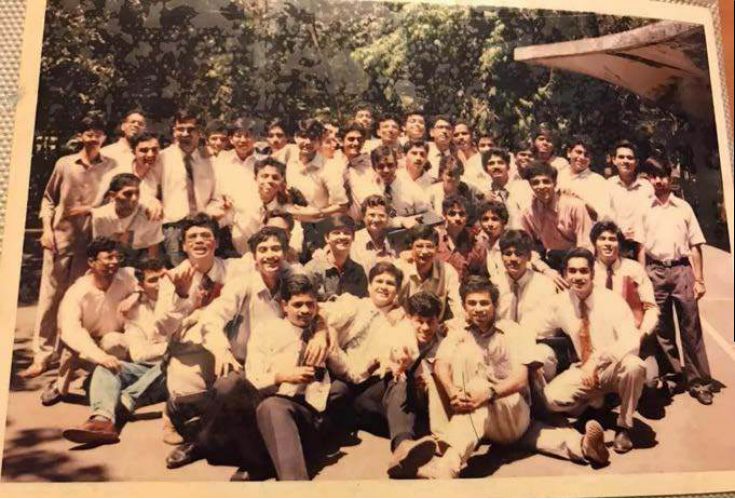
Campus life at IITB gave him something lasting, beyond grades, a worldview of life & lifelong friendships. Hostel 7 (H7), adjacent to Powai Lake (fondly called the “Lady of the Lake”), was periodically visited by snakes and per lore even alligators! Shashi’s H7 wing was also home to many alumni who went on to make their mark, including Kanwal Rekhi. Adjusting into the IITB environment wasn’t an easy transition. Shashi was acutely aware that he dressed & spoke differently (his Hyderabadi accent was there for all to hear & might have come across as funny!). A recent interaction with the legend, Kanwal Rekhi revealed that he got by with a threadbare vocabulary of English but also mentioned with a wry smile that once you make it in life, even your supposedly awkward accent seems cool! Notwithstanding these early teething issues, Shashi soon enough hit his stride. He could see all around him that there were others too who had earned their way into IITB from a township upbringing. The Performing Arts Festival (PAF), an inter-hostel competition at IITB, was a revelation. Shashi took part twice in winning teams, once alongside the ladies’ hostel, H-10. “Every time you do a different script, it’s a different experience. It’s like you’re living some fantasy for that number of days. It is completely orthogonal to what you do in engineering,” he says. “It helps a different faculty of your personality blossom.” It was an early lesson in coordination and pulling something off collectively on a shoestring budget.
Shashi also remembers an economics professor, whose name escapes him, who wasn’t constrained by the syllabus and introduced the class to Milton Friedman alongside the standard Samuelson. “She made sure you were exposed to both schools of thought without imposing her own preference,” Shashi recounts. “That is rare.” He would later connect that class to a speech by PM Narendra Modi decades on.
“From November to March, I would have severe wheezing,” he says. “If it really got bad, you had to cycle to the campus hospital in the wee hours for a shot & on one occasion had to be hospitalized as well.” These seasonal health struggles took a toll on his academics. Many ambitious students in his position might have considered themselves failures. Not Shashi. Though he enjoyed Chemical Engineering, especially the mathematically oriented Methods in Chemical Engineering course taught by Prof. S.K. Bhatia in his final semester, “I ended up knowing what I didn’t want,” he says. Shashi didn’t want to work in a chemical plant due to health reasons, nor did he want to go abroad simply because his peers were. What came his way instead was an opportunity at Engineers India Limited (EIL), a premier public-sector design consultancy, that he enthusiastically took up after graduating from IITB. EIL set in motion a series of events that changed the trajectory of his career. These decisions & traits demonstrate a flexible & pragmatic approach that are invaluable in real-world settings, becoming apparent in the next chapter of Shashi’s life.
Telegrams to telecommunications via a leap of faith to Infosys: Corporate adventures & Tech transitions beckon
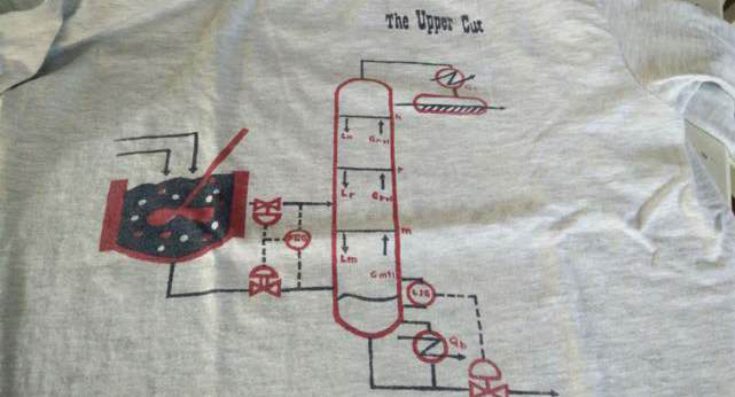
His first job placed him in the R&D center of EIL, in their Noida-based Environmental Engineering division, staffed predominantly by civil engineers who hadn’t exactly requested a Chemical Engineering graduate from IIT Bombay. The General Manager’s opening remark has stayed with him to date: “I don’t know why they’ve sent you here. I didn’t ask for you.” Shashi shrugged off his disappointment at not getting to work on plant design and process control, a theme he held dear to his heart, quite literally on one of his prized T-shirts from IITB.
What seemed like a dead end eventually paved his path into India’s burgeoning IT industry. The EIL R&D center had access to ERNET, India’s early academic internet, via a shared DOS machine usable by the entire building! When Shashi’s classmates, freshly landed in US universities, began emailing each other, he shared with them the communal email address of EIL. Forty to fifty emails arrived daily; his General Manager, initially perplexed, realized Shashi knew how to use this strange new tool and even co-opted Shashi to email some of his contacts!
Soon Shashi was procuring a 14.4 kbps modem, setting up a dial-up connection shared with the Election Commission, and downloading software that was also used by the US Environmental Protection Agency (EPA) to model pollutants dispersing in the atmosphere around Delhi. Notwithstanding these experiences, Shashi mentioned: “I realized I still wasn’t going to be a brilliant chemical engineer,” “But I was also not mentally prepared to switch to IT.”
One of Shashi’s IITB classmates who too had joined EIL nudged him to take a leap of faith into the booming IT industry in India. As luck would have it, an advertisement from the nascent Infosys appeared in the newspaper & he applied. Infosys sent Shashi an interview call by telegram that arrived two weeks late at a senior’s address, who then tracked Shashi down to his sister’s home. Running a fever, he showed up anyway, took the test, cleared the interview, and was onboarded, a story with equal parts serendipity and doggedness.
At Infosys’s Bangalore headquarters, he discovered a knack for algorithmic thinking & writing programs. Shashi was assigned to their telecom unit; he shifted to Dallas and worked on Nortel accounts through the C++ era. When Infosys incubated one of its first internet startups, OnScan, Shashi’s background in wireless communications made him a natural fit for the core team in the San Francisco Bay area. The next eighteen months were, in his words, “the most instructive and formative months of my life.” Arvind Rao, a Bay Area CEO, IIT Bombay alumnus and former McKinsey consultant took the junior Shashi under his wings, into boardrooms to pitch wireless data applications. “Each of you knows a little bit of something, but you pull it off at the end,” he says, echoing Shashi’s PAF experiences almost verbatim! Shashi quickly adds the distillate of life lessons from his tech innings: “So you move to newer innovative areas every few years.
One lesson was learning cannot stop. I must keep reinventing.
And if you’re comfortable with that, then you’ll navigate life, right, but if you always seek a comfort zone, and you want predictability. Then, it has its own implications.” He added with a sense of glee: “So now I’m getting a slightly better feel for these twists and turns.”
Fifteen years at Infosys made him a core participant in one of India’s great post-liberalization corporate successes, the era when N.R. Narayana Murthy said, “If you want to see the future of India, look at Bangalore, look at Infosys.” Shashi neatly sums up the experience of an early entrant: “So, you saw not only the company’s growth. You also saw the value of your stock options growing. And everyone was working with a missionary zeal, right? They were putting in 18 hours per day if required, for one genuinely believed that their contributions would put India on the global tech map!” The stock options would eventually give Shashi the economic freedom to listen to his heart and chart a fresh path.
The blogger who steered a campaign: Indeed, the pen continues to be mightier than the sword
What came next surprised even those who thought they knew Shashi well. In 2004, concerned by the prevailing political climate, Shashi launched a political blog called Offstumped on the Times of India’s portal under a pseudonym. Per Shashi, “The views, of course, would shoot up, people would read, & comment. The blogs started getting noticed.” When commentator Sudheendra Kulkarni, also an IIT Bombay alumnus, quoted the blog in an Indian Express editorial in 2006–07, the anonymous writer acquired unforeseen visibility. Per Shashi: “That was the first time that something from the blog word made its way to the mainstream print word, at least in India.”
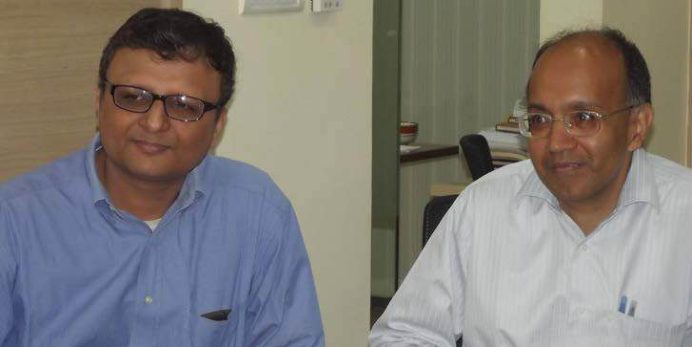
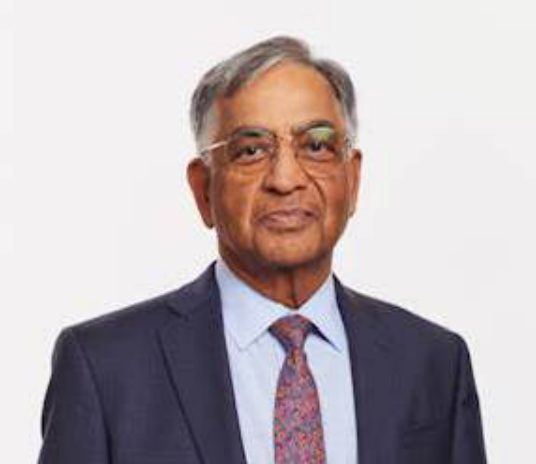
The blog’s sustained engagement with Narendra Modi’s governance ideas in Gujarat, at a time of fierce media hostility, brought Shashi to the attention of CM Modi’s circle. By 2011, he had an audience with Modi in Ahmedabad. By 2013, he had moved back from the US to India, joined yet another IITB alumnus, Rajesh Jain’s Niti Digital (please see photo on this page), and was helping design the digital strategy for the 2014 general elections. The engineer, the Infosys veteran, the anonymous blogger had improbably become a behind-the-scenes driver of one of the most consequential electoral campaigns in Indian political history.
The IIT Bombay network, he notes with warmth, was a constant guiding light through this journey: Arvind Rao at a startup, Sudheendra Kulkarni on the blog, and later Nandan Nilekani too. “When I look back, it is just too good to be true: IIT Bombay alumni came into my life and mentored me at crucial points,” he says. Shashi stresses, especially to younger folks, that they shouldn’t feel shy. Reach out and pay it forward is the way.
On being asked whether he got the itch every few years to pivot to something drastically different, he smilingly ascribes his transitions to the confidence that he has the basic toolkit that could be effectively brought to bear on a challenge irrespective of its nature. That’s exactly how it panned out in his next endeavor to lead an iconic government body.
Reinventing Prasar Bharati & reimagining public broadcasting: Leading from the front
His contribution to Niti Digital was the back story to his next innings as a leader. Shashi says, “When the CEO position at Prasar Bharati (PB) overseeing Doordarshan (DD) & All India Radio (AIR) opened in 2017, I had the interest and the know-how, and the government wanted to infuse new thinking rather than go with how things have always been functioning there.”
So, in 2017, Shashi was appointed CEO of Prasar Bharati, the first non-bureaucrat, and the first person from outside the broadcasting world, to hold the position. Shashi reflected on major collective accomplishments during his tenure at PB:
He inherited an organization “operating in the 1990s,” with umpteen ageing transmitters for rooftop antennas occupying spectrum that could power 5G. “They were still being operated just to keep people active in various parts of the country with hundreds of crores being spent on electricity besides security. To phase that out, free the spectrum, that was one of the biggest changes we made,” says Shashi.
Modernizing the organization: “There were no tangible IT systems, hardly any digital. So, it was almost two decades behind where corporate organizations had to be. So, get them into the modern era, with contemporary IT systems, and develop a digital plan.”
When COVID arrived, Shashi’s earlier infrastructure decisions proved consequential. DD Free Dish, a free-to-air satellite platform with ~fifty million household connections, became the medium through which millions of children without internet broadband access attended school during the lockdowns.
There was also the matter of the archives: DD’s treasure trove of historical footage, locked away, “family silver,” as insiders called it. Shashi prioritized digitizing this national treasure and making it available on YouTube; “Empty the silverware from the vault” was his mantra.
Adapting Public broadcasting to newer ways of communication: Shashi marshalled resources to get a digital footprint for every radio station, every TV channel across India onto social media. Per Shashi “Traditionally broadcasting has been a one-way exercise. But now with digital it becomes two ways because people are talking back to you, giving you feedback, and reacting to what you are putting up. So, you must monitor what reactions are coming through social media and so on.”
Shashi listed retaining traditions while moving the organization into the 21st century as both a challenge as well as an accomplishment, especially as user options now include YouTube and Spotify channels.
A picture is indeed worth a thousand words: Most of our generation grew up listening to the radio guys, we never knew who those people were. So, AIR tried a new experiment. Per Shashi, “We stuck a camera into the commentary box, in the studio or on the ground. You could finally see the commentators.”
The Reuters Institute for the Study of Journalism, UK, has for four consecutive years rated AIR as India’s most trusted news source, a statistic Shashi beams with pride as simply heartwarming. “Trust is a treasure,” he says. “You cannot compromise on it, especially during any big event or a crisis such as COVID.” On broadcasting by the public (as distinct from public broadcasting), Shashi’s view is that this is indeed a huge challenge. “Where does one verify its authenticity?”
His distilled leadership philosophy of being humane yet not emotional is characteristically practical: “You walk in from the private sector, you think you can get everything done and then you realize the world works differently at a different pace. So, yeah, you learn the hard way the need to align with stakeholders, the constituency that you’re trying to address. Don’t try to do Big Bang reforms for they aren’t easy to pull off. Take every small win. In public office, you must operate with a sense of detachment or else one will not be able to deal with the kind of pressures that come up. Carry your resignation in your pocket & be ready to walk away.”
Parting thoughts: Staying Hungry, Staying Foolish while still Walking!
Today, Shashi chairs the Central Board of Film Certification (CBFC) while staying deeply engaged with questions of AI viewing it more as an augmenter, science education and outreach, and India’s sovereign technological future. He worries about diminishing curiosity and critical thinking, casualties of short-form content and the infinite scroll, and about private-sector investment in Indian AI not keeping pace with the government’s mission-mode push. Enthusiastic adoption of AI by the public is what excites Shashi.
He recharges, he says, by walking, plain and simple. This has parallels with a saying attributed to Albert Einstein: “Life is like riding a bicycle. To keep your balance, you must keep moving.” Shashi still reads old books and encourages everyone to learn Sanskrit. He stays connected on the Hostel 7 WhatsApp group, where old friends still recall stories that might embarrass a public figure.
At his core, he is the same person who gravitated towards physics books he couldn’t comprehend at a Soviet book fair in Hyderabad. What has remained constant through his varied stints is the same ingredient: curiosity and learning. The day you stop learning, you merely exist.
We return to where we started. Shashi spontaneously admits that he fits the mold of an “average” student. Yet it is this average student who went on to be conferred with the Padma Shri this year & was a guest of honor at the IITB convocation. Few careers have been as improbable, as wide-ranging, or as quietly consequential as that of the young man from Hostel 7. Curiosity, unbridled courage, risk-taking & reinvention might be ingredients of Shashi’s magic potion. Of course, patriotism might be the underlying driver for Shashi’s thoughts on the future of India, which after considered thought he defines as Inevitable. We raise a toast to one of our very own, a Baazigar who carved out his own scenic trails rather than follow the beaten path.
About the author

Shashi Shekhar Vempati (IIT Bombay, Chemical Engineering, 1995) is a Padma Shri awardee (2026), recognized for his contributions to public broadcasting, media reform, and digital policy. He led Prasar Bharati, overseeing Doordarshan and All India Radio, from 2017 to 2022, and currently chairs India’s Central Board of Film Certification. He also serves on the board of the BharatGen AI consortium. A bestselling author, his book Collective Spirit, Concrete Action examines the influence of Mann Ki Baat on contemporary Indian society.

Comments
Comments open soon.