Design & Creativity
Making Stuff Up
An engineer, artist and stroke survivor makes the case for keeping your creative side alive. When AI can code, imagination becomes your edge.
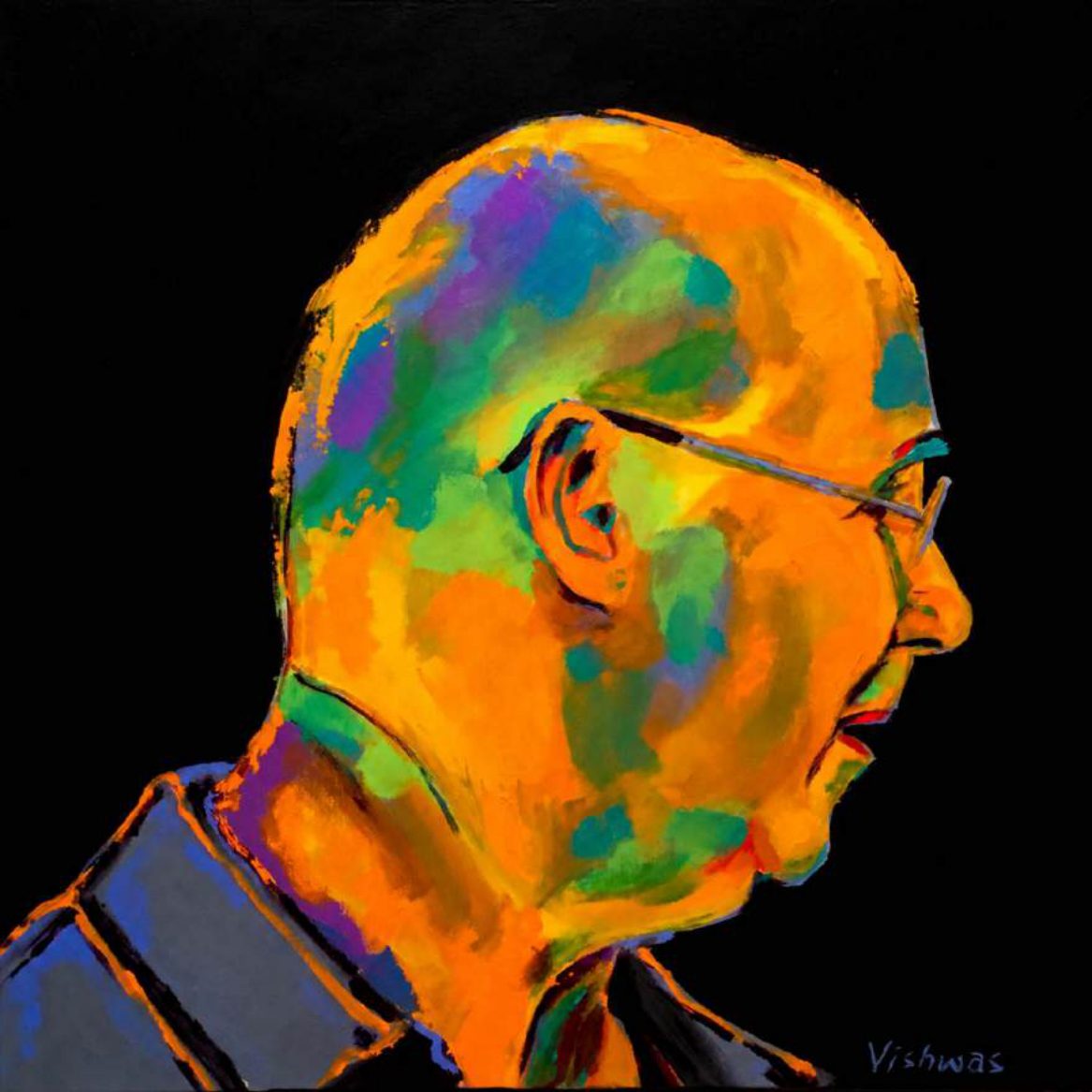
In 1979, I left IIT Bombay and arrived in the United States carrying a Master’s degree in Computer Science, a thesis on Artificial Intelligence, and a sketchbook I had no intention of putting away.
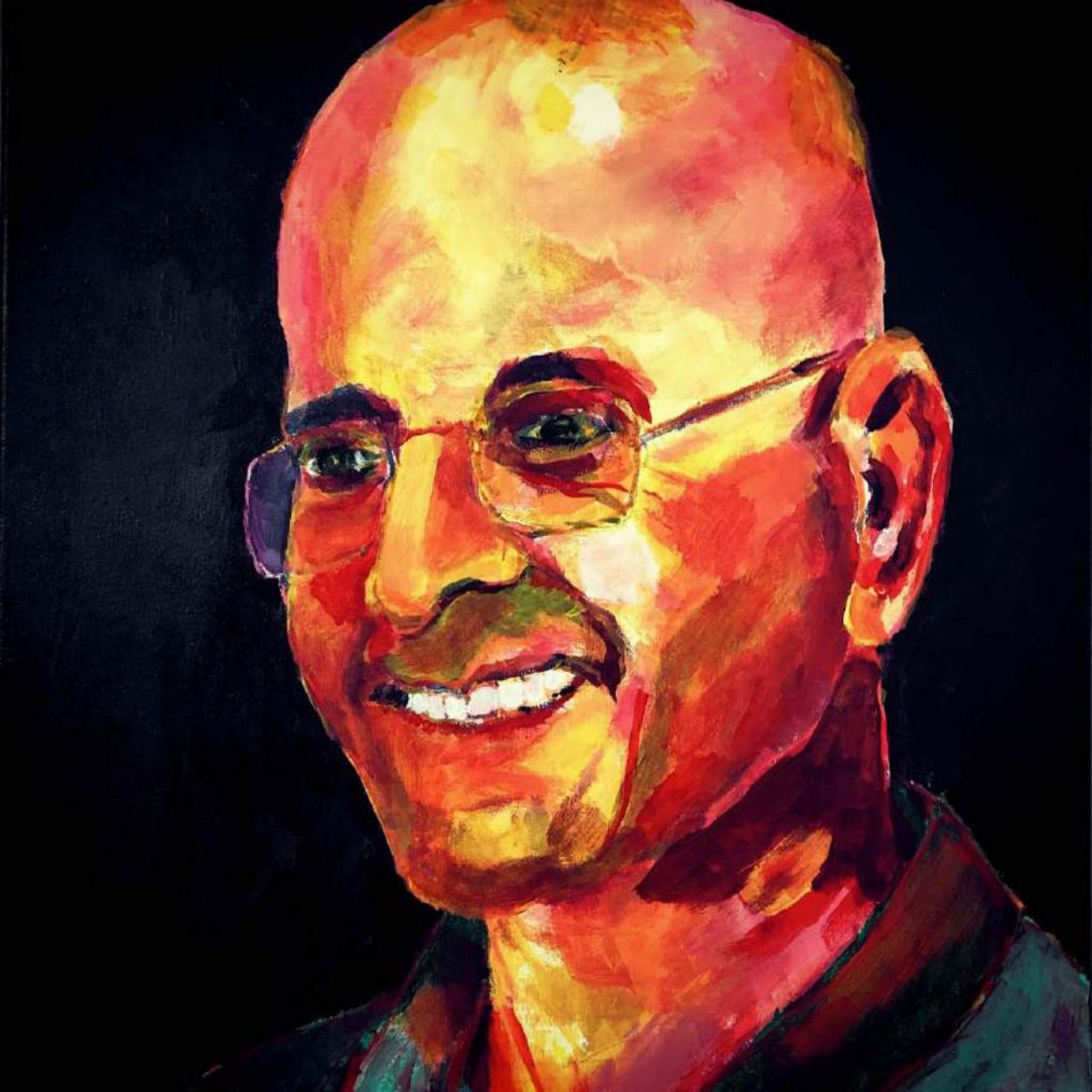
The degree was my parents’ idea, and I remain grateful for it. As a boy in India, I was certain I would become an artist. I drew constantly. But I was also good at mathematics, and in the world I grew up in, that settled the matter. You were a “math person” or an “arts person,” and if you were fortunate enough to be the former, you did not squander it on the latter. So, I became an engineer, and I kept drawing anyway — quietly, stubbornly, through a career in software and long past it.
I used to think of this as a compromise. I now believe it was the best professional decision I never consciously made. And in the age of AI, I believe the case for it has become urgent — especially for younger alumni who feel, as I once did, that they must choose between technical excellence and creative expression.
The false choice
The “left brain versus right brain” framing in my title is, neurologically speaking, mostly folklore. But the metaphor endures because it captures how early we sort people — Indian engineering culture is particularly efficient at it, and by sixteen most of us have been told which half of ourselves to feed. My experience is that the two halves feed each other, and that starving either one weakens both.
Consider what drawing a portrait actually demands. It requires you to see what is in front of you rather than what you assume is there — the actual shadow under the eye, not the symbol for “eye” your brain wants to substitute. Every engineer will recognize this discipline. It is debugging: the bug is never where you assume it is, only where the evidence says it is. Portraiture made me a better debugger than any course I ever took, because art is training in the defeat of assumption.
The traffic runs the other way too. Composition in painting is architecture: what to emphasize, what to subordinate, what to leave out entirely. Knowing when a painting is finished — when one more stroke makes it worse — is the same judgment as knowing when to stop engineering a system. Restraint is a creative skill, and it is the rarest skill in software.
What building taught me about people
I settled in the Washington, DC area in 1981 and spent the following decades building software while the industry itself grew up around us — mainframes to personal computers to the internet, each wave arriving faster than the last. I formally retired in 1998. But engineers never really retire; we just lose the badge. I kept building through the decades that followed, and when the smartphone arrived I was fortunate to be among the original developers of Grindr.
The deepest lessons of my career came from that kind of product work, because the hardest problems were never algorithmic. They were human. Location-based software was uncharted territory then, yet the technical puzzles were the easy part. The real questions were about people. What do they want? What are they afraid of? What will they never tell you in a survey but reveal instantly in how they behave? For gay men of my generation — who had spent decades learning to find each other carefully, sometimes at real risk — an app that announced your presence to nearby strangers had to understand fear as deeply as it understood desire. I could contribute to those questions not merely because I could code, but because I had lived them. Answering such questions is an act of imagination — of empathy, which is imagination applied to other people. The technical work was necessary. It was never sufficient.
Relearning to see
In 2016, I suffered a debilitating stroke. Among the many things it took was my ability to paint the way I had painted my whole life.
It was not my first negotiation with mortality. In 1986 I was diagnosed with HIV and told I had a year to live — a prognosis I carried for two decades, and one that rearranged me in ways I am still discovering: when you believe every year is your last, you stop deferring. You paint now. You love now. Cancer came later and was, by comparison, almost routine. But the stroke was different — a stroke takes your abilities and makes you watch. For the first time, I thought seriously about ending my life.
What pulled me back was Joe, my partner of more than thirty years, who had anchored me through the worst years of the AIDS epidemic, told me I needed help. So, I met my therapist. The conversations that followed became my memoir, Gay Crow.
The title comes from an Indian fable about a crow who is perpetually happy — not because his circumstances are good, but because he chooses what to dwell on, keeping the good and letting the bad recede. I once took that as a lesson in temperament; I now understand it as a lesson in craft. Optimism is an editorial decision — deciding what belongs in the frame — and that is the artist’s oldest skill, applied to life itself.
So, I relearned to paint, approaching it the way an engineer approaches a broken system: decompose the skill, isolate what still worked, rebuild the rest. I began drawing with my left hand because the right hand was disabled.
My gallery today is divided into two sections, “before the stroke” and “after the stroke.” The after paintings are looser, less controlled, in some ways more honest. Some viewers prefer them. My analytical training carried my recovery; my creative practice gave me a reason to recover. Neither half of me would have survived alone.
That experience settled the question for me permanently. Creativity is not a talent you are issued at birth in a fixed quantity. It is a practice — and like any practice, it can be rebuilt, even from wreckage. Which means it can also be built from scratch, at any age, by anyone reading this.
Why this matters now
When I wrote my AI thesis in the 1970s, the field was an academic curiosity. Half a century later it works, and it has changed the economics of engineering in one specific way: routine technical execution is becoming cheap. Code that once took a week now takes an afternoon of supervising a model. But it needs judgment, reliability and accountability that is provided by humans.
Ask for a solution and you receive the most plausible one, and most of what I get back is competent and lifeless — The scarce contribution has moved up the stack: framing the problem correctly, taste, the judgment to recognize when the plausible answer is wrong, knowing what is worth building at all. The machine can generate a thousand options; someone still has to see. And seeing past the obvious is what creative practice trains. Art, remember, is training in the defeat of assumption.
This is not a threat to engineering careers so much as a redefinition of them. The engineers I see thriving with these tools work less like builders and more like editors and directors: they know what they are trying to say before the machine starts talking, and they can tell the difference between output that is finished and output that is merely fluent. Finished versus fluent may become the defining professional distinction of the next decade, and nothing trains the eye for it like making things yourself.
I say this as a practitioner, not a spectator. In my eighth decade I have begun composing music using AI — a medium that was never within my reach before, and one the stroke certainly did not bring closer. I began converting the poems that I had written in my youth and making them into songs.
Here is what the work actually looks like. I begin with a poem; a voice and a set of lyrics I want to hear set to music. The AI returns possibilities within seconds. Most are technically polished and emotionally empty, and that is where the real work begins — listening, rejecting, redirecting. Sharpen this line. Slow this passage. That chorus is sentimental in the wrong way; again. A finished track stands on the far side of a thousand rejections, and every one of those rejections is mine. The AI has never once known when a song was done. The tool is astonishing, and it is nothing without a point of view.
Practical reflections
For younger alumni and mid-career professionals, let me be concrete.
Treat a creative practice as training, not escape. An hour a week of drawing, writing, or music made with the intent to improve builds judgment that passive consumption never will. I painted through every demanding year of my career, and the years I created the most were the years I engineered the best.
Make something with no specification. No client, no ticket, no prompt from anyone but yourself. Self-directed creation is how you develop a point of view, and a point of view is what you contribute when all the machine-generated options look equally fine.
Practice saying why something is good. Taste is not mystical; it is built through repetitions of judgment, the way muscle is built through repetitions of load. Review code for its clarity, not only its correctness. Critique a design until you can name exactly what is wrong with it.
Claim the creative territory inside your technical work. Problem framing, architecture, naming, the decision of what not to build — these were always the creative parts of engineering, and they are precisely the parts the machines handle worst. Write the design document nobody asked for. Rename the module until the name teaches.
Do not defer this to retirement. I speak with some authority here: I retired in 1998 and have been building ever since. The habit you do not form at thirty will not be waiting for you at seventy
Refusing the choice
Somewhere an alumna is being told, as I was, to be serious — to set aside the sketchbook and the half-written novel and concentrate on her real work. My message to her is simple: refuse the choice. It was always a false one, and the machines have now made it an expensive one. The engineer who can imagine and the artist who can build are not two people competing for your time. They are one person, and in the age of AI, that person holds the advantage.
About the author
Vishwas Pethe (IIT Bombay, 1979) spent his career in software and AI in the United States and was one of three original developers of Grindr. He lives in the Washington, DC area. His paintings can be seen at vishwasart.com, his memoir Gay Crow (2021) at gaycrow.com, and his music under “Vishwas Pethe” on Apple music, Spotify and YouTube.

Comments
Comments open soon.