Idea Watch
Heavens! When Galaxies Collide
A nearby galaxy’s scattered stars and displaced gas conceal a violent encounter. Himansh Rathore reconstructs the collision that transformed our cosmic neighbour.
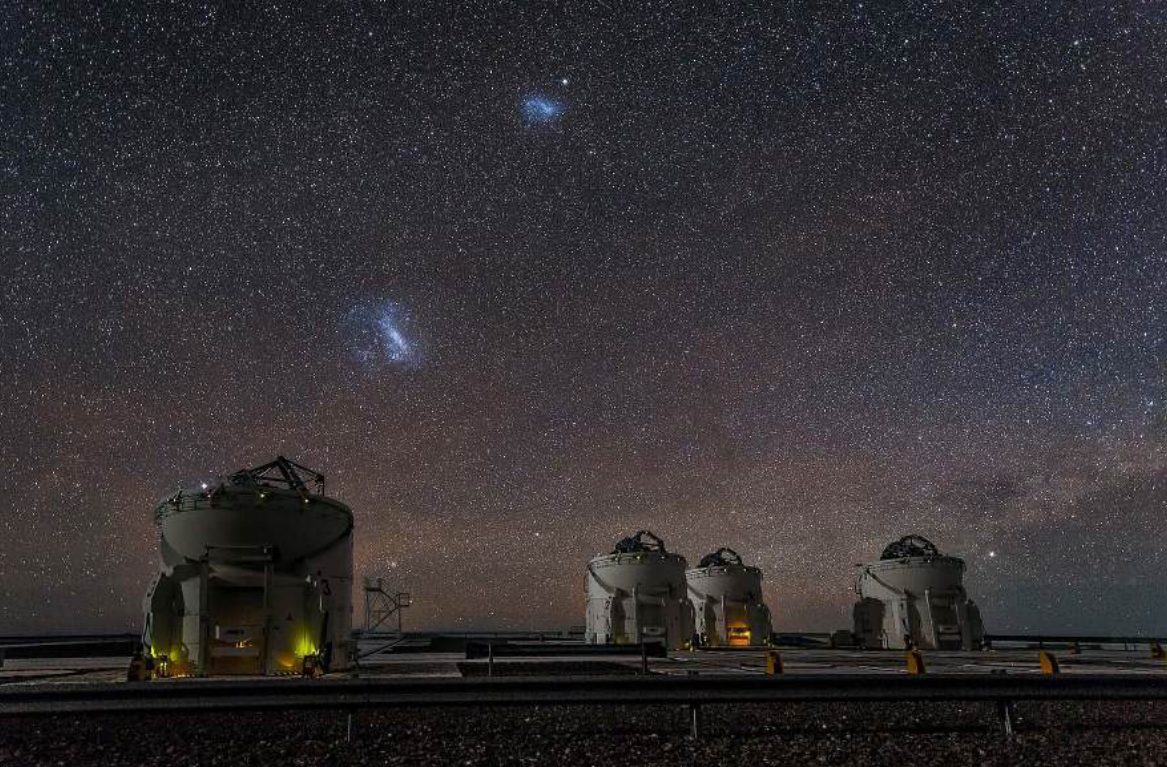
We are used to seeing the night sky as static, unchanging. On the contrary, the universe is full of life. Galaxies are constantly smashing into each other, forming new worlds. Most of the time, these transformative processes are beyond the limits of human perception. But this time, the universe has given us an opportunity to witness a cosmic crash right in our backyard. All we need to do is look up, and see a dramatic transformation in live action. The two most prominent satellite galaxies of our Milky Way - the Large and the Small Magellanic Clouds (LMC and SMC in short) are locked in a gravitational dance. This ongoing galaxy interaction is the key to solving some of the biggest mysteries about the shapes of our galactic neighbours — that have eluded astronomers since the last 70 years!
The Magellanic Clouds seen above are the two most prominent satellite galaxies of our Milky Way. Just like how the Moon orbits our Earth, these satellite galaxies orbit our Milky Way. The LMC and SMC are visible from the Southern Hemisphere through our bare eyes, without requiring any binoculars or telescopes. They are located close together in the sky, separated by around 10 degrees (the size of 20 full moons), with the SMC being further south. Countless civilizations in South America, Southern Africa, and Australia have documented the LMC and SMC, and some have referred to them as Cranes dancing with each other in the night sky.
Humanity has a long history of personalizing cosmic phenomena, from imagining human and animal forms in constellations to — in this case — imagining the LMC and SMC as dance partners. But this time, we have scientific evidence that our ancestors might actually be right. In fact, it’s not just that the LMC and SMC have been dancing around each other, they very likely have gone through each other in the recent past — a collision that has catastrophic consequences for the smaller of the two galaxies – the SMC.
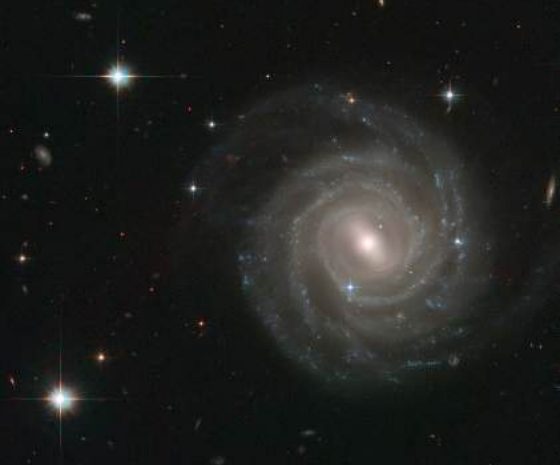
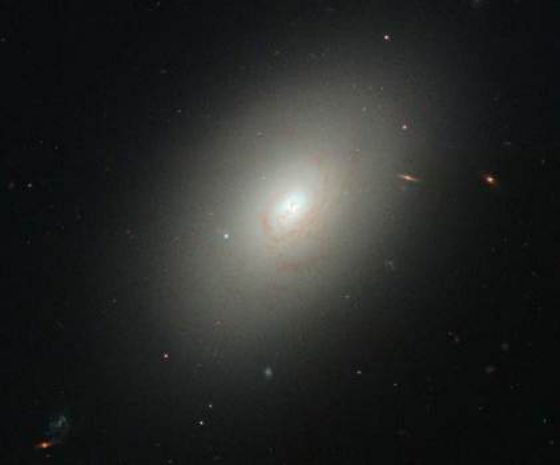
The shape of the SMC has been one of the biggest unsolved puzzles in our local universe. Galaxies mainly come in two shapes (see above) — disks (like a frisbee) and ellipsoids (like an egg). A galaxy’s shape is determined by, among other things, the kind of matter it contains. All galaxies in the universe are composed of stars, gas and the ever elusive dark matter, with the latter dominating the mass content of a galaxy. However, the relative composition of stars and gas varies from galaxy to galaxy, and plays a crucial role in determining the galaxy’s shape.
Generally, galaxies that are full of gas tend to be disk-shaped, where stars rotate around the galactic center. For example, our Milky Way, which is shaped like a disk, contains a decent amount of gas — roughly 10% of the amount of stars. A simple way to understand why gas rich galaxies are disk-shaped is through the concept of energy dissipation. As the gas falls towards the galaxy’s center due to the gravitational attraction, gas atoms lose energy by colliding with each other. As they lose energy, the motions of these atoms become more orderly as opposed to random, making the gas eventually settle down into a rotating disk where gravity is balanced by the centrifugal force. Note that the centrifugal force is the same force that helps achieve the disk-like shape of a spinning ball of dough. Now, stars are born out of dense clumps of gas, so they also rotate in the same plane as the gas, resulting in a disk-like structure of the entire galaxy.
Now, let’s apply our understanding to the SMC. The SMC is a very gas rich galaxy — it has more amount of gas than stars ! As such, based on the theory I described above, we would expect the SMC’s stars to rotate in a disk. However, when astronomers measured the motions of the SMC’s stars, to their surprise, there was no sign of a rotating disk ! So how do we reconcile the SMC with our theories ? Is it that our theories are completely wrong, or are we missing something crucial ? My research has solved this problem, and it turns out the solution fundamentally changes our understanding of our neighbours.
As I started pondering over the mystery regarding the SMC’s shape, me and my PhD supervisor Prof. Gurtina Besla at the University of Arizona suddenly realized — what if the SMC’s larger companion – the LMC, had something to do with the problem ? The inherent assumption in standard theories is that the galaxy lives in isolation, and it is not being affected by the neighbouring environment. However, the SMC is not isolated; it is experiencing a significant amount of gravity from its companion — the LMC. Motivated by this epiphany, we started to investigate how the motions of the SMC’s stars would be affected by the LMC’s presence.
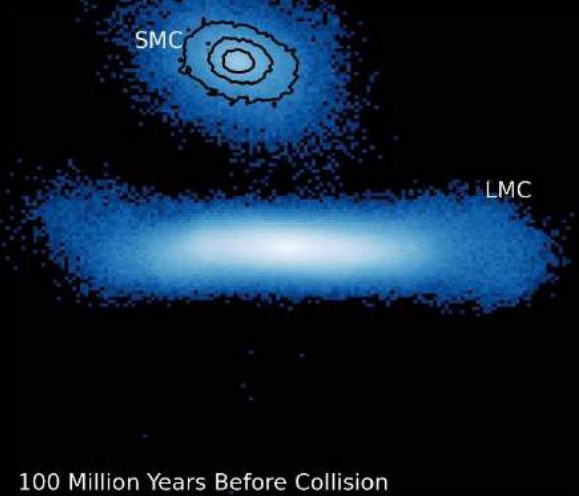
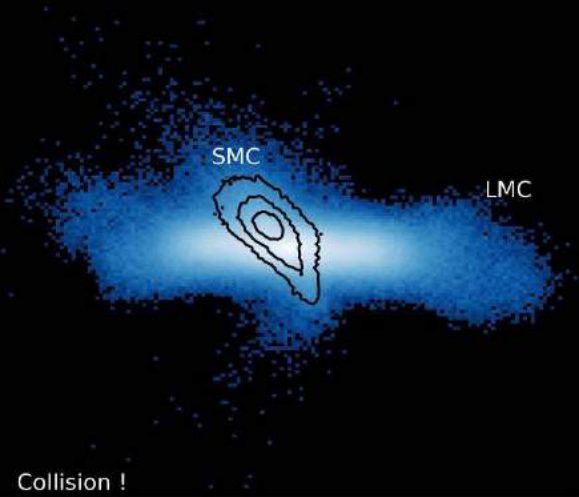
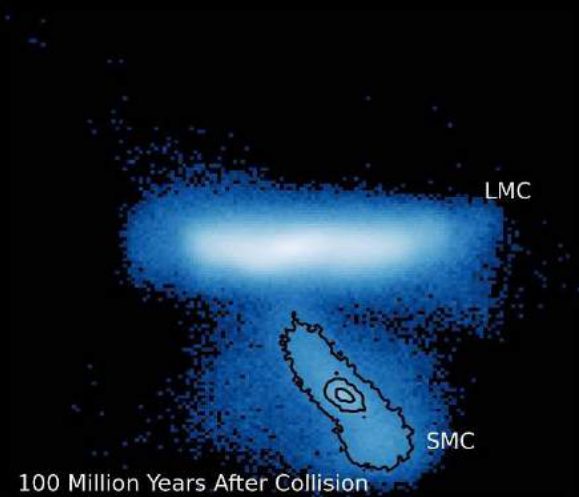
This was not going to be an easy investigation. Keeping track of the motions of millions of stars was not possible through pen and paper calculations alone. This is where simulations came into picture. With advancements in supercomputing power, astronomers have been able to recreate the motions of stars and gas in galaxies inside a supercomputer. I started using simulations of the Magellanic Clouds and tested various scenarios of the SMC going around the LMC, and how the SMC’s shape gets affected in each case. I quickly realized that scenarios where the SMC only weakly interacts with the LMC, i.e. remains far away, are not able to explain the extent of the observed randomness in the motions of the SMC’s stars. To explain the observations, I had to use a scenario in which the SMC had a very strong encounter with the LMC — only possible when the SMC crashed through the LMC in the past. Moreover, this encounter was fairly recent — happening barely a 100 Million Years ago. For context, our solar system is at least 4 billion years old. The dinosaurs may have seen the SMC crashing through the LMC ! This crash completely changes the SMC’s identity. An initially disk-shaped SMC is transformed to an ellipsoid, that too over a minute timescale compared to the age of the universe. The long-standing mystery behind the SMC’s shape is finally resolved, and the solution gives us a valuable lesson that galaxies are not isolated entities — the external environment constantly acts to influence how a galaxy evolves.
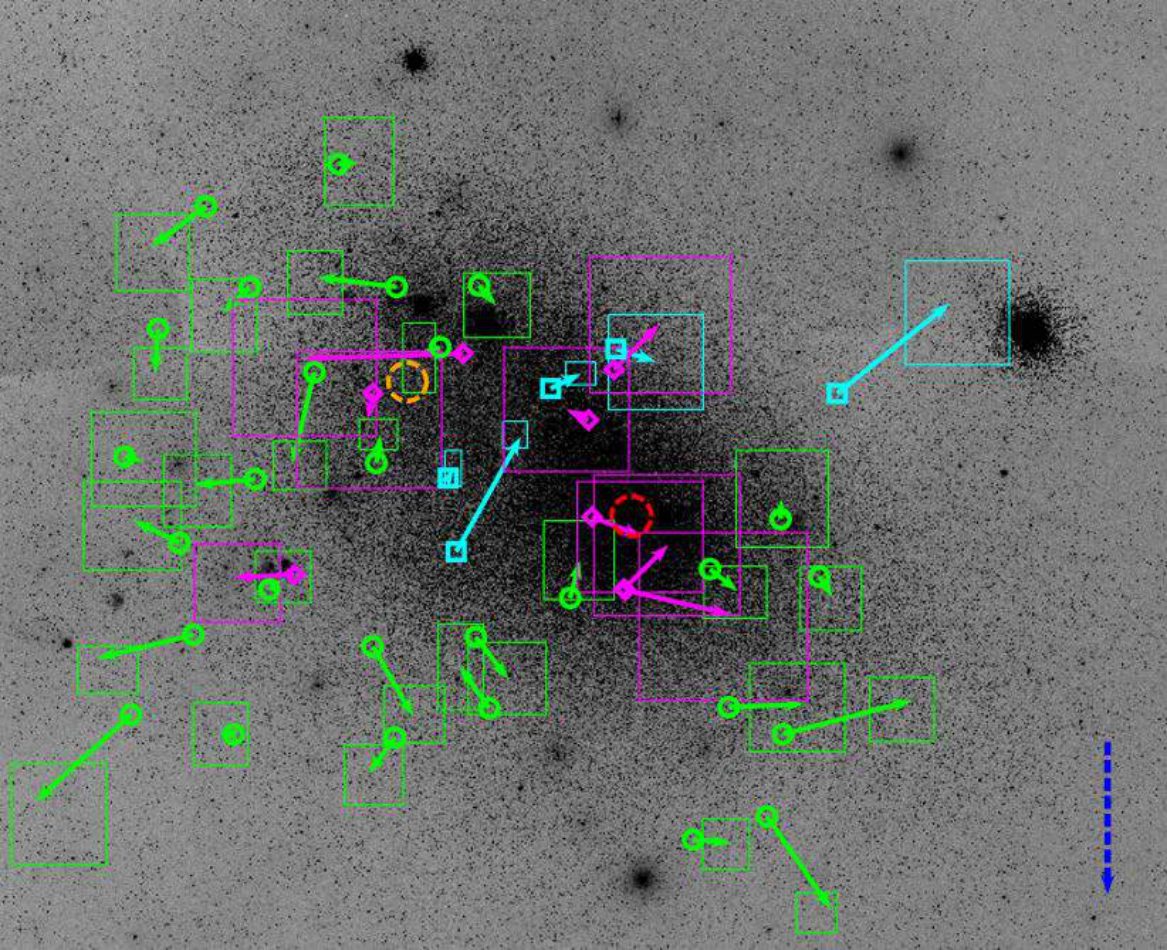
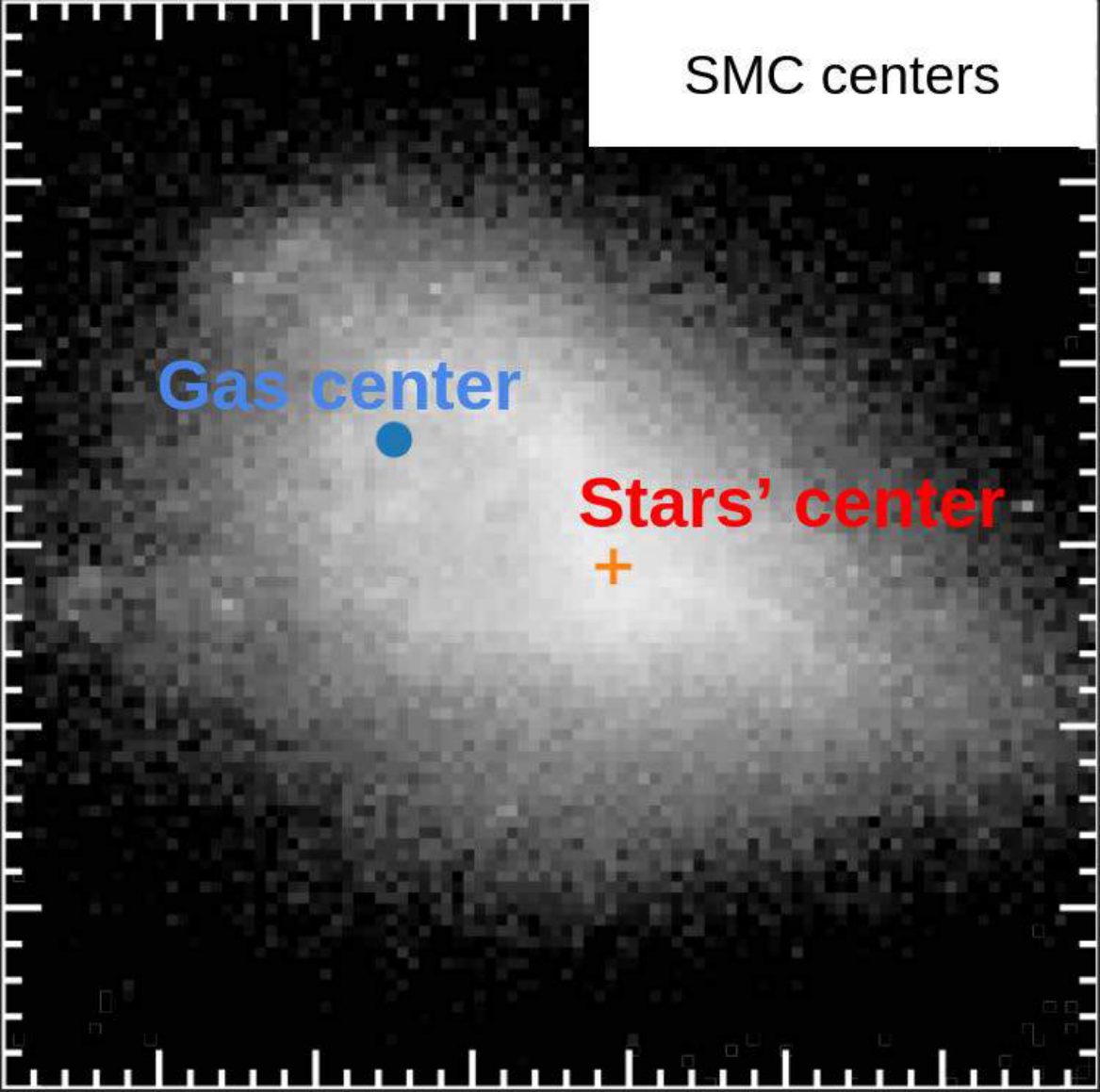
After this accomplishment, we suddenly realized that the SMC colliding through the LMC could solve another puzzling problem with this galaxy. It turns out that the SMC’s stars and gas do not share a common center (see Figure 4). The centers of the stars and gas are separated by almost 6000 light years. This is a significant separation as the SMC galaxy is barely around 12,000 light years in diameter. How do you get the stars and gas in a galaxy to be separated by an amount that is half the galaxy’s own size ? We would normally expect the gravitational attraction between stars and gas to keep them together. There must be some other force that is countering gravity in the SMC. The answer to this long-standing question again lies in the LMC.
To tackle this problem, let’s first understand a concept of fluid dynamics - called ram pressure. Ram pressure is the same force that causes the water droplets in our wet hands to fall off when we dry our hands near a blower. Fundamentally, this pressure is a result of an interaction between two fluids, where in the case of our wet hands, the air from the blower (a fluid) is interacting with the water droplets (also a fluid) in our hand. The same force acts on the SMC’s gas when it crashes through the LMC. The LMC’s gas exerts a tremendous amount of ram pressure on the SMC’s gas during the collision, which causes the SMC’s gas to be “blown away”. Since this force is due to fluid-fluid interactions, it does not act on the SMC’s stars, causing a net shift of the gas with respect to the stars. This explains why the SMC’s stars and gas are not coincident with each other, solving another long-standing challenge with this galaxy. This elucidates a previously under-appreciated consequence of galactic collisions — they not only dramatically affect a galaxy as a whole, but different components of a galaxy (like stars and gas) are affected in different ways !
My PhD advisor and I realized that the significance of this crash in our backyard is not just limited to explaining the SMC’s properties, but it can help us shed light on an entire class of galaxies — i.e. galaxies in the early universe. With the advent of modern space observatories like the James Webb Space Telescope, astronomers are beginning to unravel the galaxies in the early universe — galaxies born barely a few 100 Million years to a billion years after the big bang. The early universe was nothing like the universe we live in today. It was a lot denser, and galaxies were crashing into each other all the time. Excitingly, a lot of the galaxies in the early universe are similar to the LMC and SMC when it comes to how massive they are and what their chemical makeup is. This means that the LMC-SMC collision brings an incredible opportunity to understand in detail the physical processes that shape galaxies in the early universe. This endeavour requires us to develop the next-generation supercomputer simulations of how the LMC and SMC have collided with each other. By leveraging state-of-the-art supercomputing infrastructure, I am currently building these simulations.
To conclude, next time any of you end up being south of the equator, or even in the southernmost parts of India, do look up and try to find the Magellanic Clouds. The sight would be a front-row view to a cosmic transformation !
Visualization of how the SMC looks like on the sky. The centers of both stars and gas are marked. The two centers are separated by around 1 degree on the sky (two full moons), which corresponds to 6000 light years at the SMC’s distance. This separation can be explained by the ram pressure exerted during the LMC-SMC collision.
About the author

Himansh Rathore — IIT Bombay, Engineering Physics, Class of 2022 (H9).
Astrophysics Ph.D. candidate at the University of Arizona and NASA FINESST research fellow.

Comments
Comments open soon.