Technology & AI
Darwin Touches AI
Computer rooms have evolved into giant AI campuses hungry for power, water and debt. Nikhil Bhandiwad follows the money back to household bills and retirement savings.
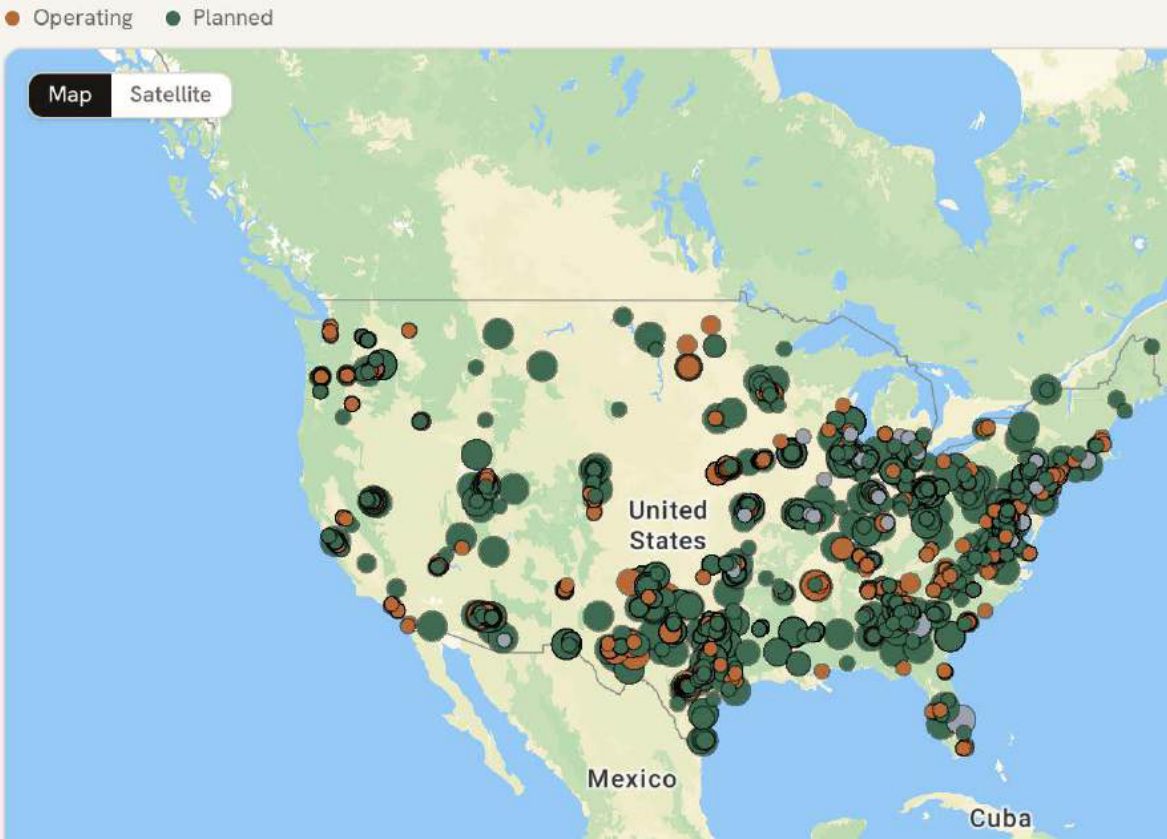
An M&A banker with decades on Wall Street called me late last year, “Have you seen the Meta Hyperion news?” he continued, “It’s massive, $28 billion, and it’s all off-balance sheet. Where are they sticking this debt?” My friend wondered why a company that invests billions was using project finance structure and burying the residual value guarantee, a derivative, in footnotes. Meta is far from being alone. Eighteen months ago, McKinsey & Co projected worldwide AI infrastructure investment of $5.2 trillion by 2030. When the firm raised that forecast in early 2026, no one blinked. Where is all that money going?
To find the answer, you have to start with a room full of vacuum tubes at the University of Pennsylvania in 1945 and follow the thread through mainframes, virtualization, and Kubernetes to the AI buildout that is now breaking the model which made it all financeable.
Where did data centers come from?
The first data center was built to house ENIAC at the University of Pennsylvania, with additional facilities at West Point, the Pentagon, and the CIA headquarters for defense and intelligence use. Secrecy mattered more than the fans and vents required to keep the machines cool. ENIAC alone drew 150kW for its 17,000 vacuum tubes, plus 40kW for the blowers to keep it from incinerating its own circuits. In the 1960s, IBM’s System/360 commercialized the use of computers; multinationals ran the same software across different machines. Mainframes drew less power than ENIAC but needed fancier air-conditioned clean rooms.
NYC’s average grid load in 1945 was 1.3 MW, which kept the subways running, the neon lights on, and millions of homes powered. These days, summer peak requirement for NYC is 10.4 GW; AI’s power backlog is 33 GW, or three NYCs on their hottest day.
How did the mainframes become the cloud?
The transition from mainframes to distributed computing came in stages. Minicomputers reshaped enterprise compute economics. As computers took hold, PCs and the client-server architecture followed. Microcomputers began filling old mainframe rooms as servers; the rooms came to be known as “data centers.” In the dot-com era, businesses wanted to operate nonstop, often without brick-and-mortar infrastructure, which ushered in larger “data centers” with thousands of servers and almost concurrently “data center as a service.” VMware introduced virtualization that led to the idea that compute could be pooled, sliced, or rented. Salesforce and AWS began offering compute, storage, and IT infrastructure delivered as a service over the web. Data centers often exceeded a million square feet and required 40–60 MW at peak, at 3–5 kW per rack. Early hyperscale builds used inefficient legacy cooling; nearly a watt of cooling for every watt of compute.
Kubernetes: What’s the relevance?
Kubernetes makes modern cloud computing (by extension today’s AI buildout) financially and technically viable. Initially developed by Google, maintained by Cloud Native Computing Foundation, Kubernetes lets engineers define the desired state of an application and manage thousands of individual application instances. The system reconciles the actual state with the desired state while automatically responding to failures, scaling, and demand changes. If a container crashes, Kubernetes restarts it; should a node fail, it moves workload elsewhere.
The Boom: Why is AI different?
A facility built for a GB200 rack with custom liquid cooling isn’t fungible in the same way a generic cloud server was. It is built for one workload, training or inference, and most often has one anchor tenant. A rack is a 7-foot-tall cabinet with its own power distribution, liquid cooling, and copper networking backplane. AI Data centers may contain as many as 10,000 multi-million-dollar racks, where each rack holds 72 GPUs across 18 trays that function as one giant server. The new data centers create enormous power demand, which is often met with behind-the-meter power generation in gigawatts. The US Department of Energy estimates that 50% of the net new energy demand will come from Data centers, while some forecast that data centers will consume almost 15% of US electricity generation.
Kubernetes is the reason a single physical facility can be sliced into thousands of billable and fungible units of compute. It converts a fixed depreciating capital asset into a “meter-able” revenue stream. If a tenant leaves, another with a different workload can use the same capacity. The utilization or value does not depend on one customer or workload.
Requirement
Power need
Cooling
Water
(onsite cooling)
Water — indirect (for electricity)
Generation
Connectivity
Land footprint
Table 1: What a Data Center Requires
Project Rainier, Anthropic’s dedicated training cluster in New Carlisle, Indiana, needed a $11 billion investment, 1,200 acres of land, almost 2 GW of power, sufficient to power 1.6 million homes, and not to mention the petabit-scale network requirements. Electricity is the ultimate constraint behind everything else: number of GPU racks, cooling load, site selection, financial structure, even the real estate lease itself.
Old Data Center
1–5 kW per rack; 40–60 MW facility peak
Air
~300,000 gallons/day
Lower, tied to grid mix
Backup Diesel generator
Single or dual fiber path
Tens of thousands of sq. ft.
AI Data Center
40–140 kW per rack; 100 MW–2+ GW per site
Direct liquid cooling / immersion
1–5 million gallons/day
Natural gas: ~2,800 gal/MWh
BTM gas turbines, GWs, always on
InfiniBand/800G+ fabric between racks
1,000+ acres for gigawatt campuses
Kubernetes continues to run the software layer of AI workloads, split into training, inference, and agents. But the fungibility via Kubernetes that made cloud computing easy to finance did not carry over to AI infrastructure. What broke the old paradigm was the hardware layer, which cannot be re-leased to another tenant. Lenders are forced to underwrite a single tenant’s bet on a single workload. This is where financial engineering such as SPVs, residual value guarantees, GPU-collateralized loans, tenant-credit-backed ratings come in.
These days a 1GW data center needs almost $50 billion to build, with two-thirds going to chips alone and remainder to the facility, power, and cooling infrastructure.
Why It Matters
Constraints on how large a facility can be
Water use of ~10k homes
Availability determines if a site is viable
Gas turbines need water for steam cycles and cooling
Grid interconnection queues now average 4+ years
A single point of failure can idle a $10M+ GPU cluster
Land, water rights, and transmission access
Era
Table 2: Cost Comparison
The flood of money: Where is it coming from?
That scale of bet raises an obvious question: who is actually paying for it? AI sector revenue in 2025 was roughly $60 billion against approximately $400 billion in capital expenditure, making the investment dependent on the debt markets. Hyperscalers issued $121 billion in Investment grade bonds in 2025 alone. SpaceX sold $25 billion in five maturities, which drew $85 billion in orders. SpaceX wants to transition towards a major AI cloud and compute provider by building both space-based and terrestrial AI infrastructure.
Facility
ENIAC
IBM’s System/360 program bet
IBM System/370 (typical, hardware only)
Project Rainier (Anthropic/AWS)
IBM’s System/360 program bet
Then-Dollars
$500,000
$5 billion
$2.25–4.7 million
—
—
IBM’s roughly $50 billion (today’s dollars) bet on its entire mainframe business is the same scales as the annual AI capex of a single hyperscaler. Alphabet alone raised its capital budget to $92 billion. Granted that ENIAC cost figures include the machine (that could do 5000 additions per second) only and not the campus around it. Nevertheless, the scale of AI infrastructure bet has impacted everything from GDP, prices ratepayers pay for electricity, and the stock markets around the world.
AI-related net issuance is now a third of the entire investment grade dollar bond market. Even that is not enough. Technology companies have moved a little over $120 billion of data center spending off their balance sheet in the last eighteen months using project finance structures: the bankruptcy-remote special purpose vehicle, or SPV. A tech company partners with a private credit fund to create a separate legal entity. The tech company then transfers the project in the SPV via a “true sale”, the SPV borrows from institutional lenders to build the project, and the tech company leases the finished facility back with a slew of legal agreements covering colocation lease, power purchase agreements, interconnection agreements, and SLAs. The capital stack is split across as many as ten legal entities, each set up for a distinct purpose. All have one common purpose: the debt never touches the parent’s balance sheet.
Today’s Dollars
~$9.3 million
~$52 billion
~$19–39 million
$11 billion
~$50 billion
Scale
baseline
~5,600x ENIAC
~2–4x ENIAC
~1,180x ENIAC
~5,400x ENIAC
Meta’s Hyperion campus, the very deal my friend called about, in Louisiana is one of the cleanest examples. A $30 billion SPV called Beignet Investor, 80% owned by Blue Owl Capital, and 20% by Meta, raised ~$27 billion in loans from PIMCO, BlackRock, Apollo, and others. Meta also gave a residual value guarantee of up to $28 billion, a promise to make the lenders whole if the facility’s value falls short. That guarantee is disclosed only in footnotes as the target payment is not probable of being owed.
Private Credit funds, Blackstone, Blue Owl, Apollo, KKR, Carlyle, PIMCO, and BlackRock now originate most data center debt. Outstanding private credit loans to AI-related companies have surged from almost zero to over $200 billion in just a few years. Morgan Stanley projects another $800 billion in data center financing via private credit over the next two years alone. The debt keeps moving, loans originated for data centers get pooled and tranched – sold either as broadly syndicated loans to the CLO machine or as rated feeders to non-bank financial institutions. Major life insurers already hold nearly $1 trillion in private credit.
Americans hold $47.6 trillion in their retirement accounts, approximately 34% of their household financial assets. Most Americans have never heard of Blue Owl, Beignet, or Hyperion yet the money from their pension funds, annuities, and other savings keeps financing the biggest infrastructure spending boom of my lifetime. The underlying assets are racks of GPUs and a power plant, at times not connected to the existing electric grid. None of this means that the buildout is a mistake. The companies that have made these bets, the “Magnificent Seven” make up roughly a third of the entire S&P 500. The flood of money is underwritten by American households through electric bills and again with a reservoir of retirement savings hungry for a piece of the AI Boom. On the front page of my FT this morning, “Wall Street groups are working with NVDA to assemble a $500 billion funding package.” As I told my friend, “NVDA will become the Bank of AI, and the debt will be on every balance sheet.”
About the author

Nikhil began his career in exploration of oil and gas in the North Sea before moving to NYC, where he spent 28 years creating & trading hybrid derivatives and complex securities for global banks, insurers, and asset managers. He has worked extensively in origination, structuring, and trading of Credit, Equity, FICC products, including energy, gas, and power markets.
Nikhil has lived in four countries, travelled to too many, and called New York home for longer than any other place. Being a Marathi-speaking South Indian from Pune prepared him well for a life explaining where he is from. He currently lives in South Florida, which often reminds him of the humid weather in Mumbai.. His interests include weather derivatives, asset intensive insurance, energy and financial markets, and high-performance computing.
Join the conversation
Comments are moderated and may take a little while to appear. Please keep the discussion respectful and on topic.
Comments open soon.